Explore Automated Packaging Machines: Guide to Line Automation
Automated packaging machines are industrial systems that fill, seal, label, wrap, inspect, and prepare products for distribution with limited manual intervention.
Integrated packaging lines coordinate multiple machines through conveyors, sensors, programmable controllers, and inspection equipment to improve production consistency, manage material flow, and support reliable packaging operations across different industries.
The right automation configuration depends on product characteristics, packaging materials, production volume, hygiene requirements, available floor space, and integration with existing manufacturing equipment. Understanding these factors helps manufacturers design packaging lines that meet operational requirements without adding unnecessary complexity.
Quick Facts About Automated Packaging Machines
Feature | Description |
|---|---|
Primary purpose | Automate product packaging and handling |
Common operations | Filling, sealing, wrapping, labeling, coding, case packing |
Main equipment | Fillers, sealers, conveyors, labelers, inspection systems |
Control technology | PLCs, sensors, HMIs, motion controllers |
Packaging formats | Bottles, cartons, pouches, trays, bags, cases |
Typical industries | Food, beverages, pharmaceuticals, cosmetics, consumer goods |
Integration options | Upstream production equipment and downstream palletizing |
Main performance factors | Throughput, changeover time, product accuracy, uptime |
Key design considerations | Product compatibility, safety, hygiene, maintenance, traceability |
What Are Automated Packaging Machines?
Automated packaging machines use mechanical equipment, electronic controls, and sensing technology to perform packaging operations with reduced direct human involvement. Individual machines may handle a single task, such as sealing a pouch, or combine several operations within one integrated unit.
An automated packaging line connects these functions into a coordinated production sequence. For example, a beverage line may orient empty containers, fill them, apply caps, inspect closures, label the containers, and transfer them into cartons. The actual arrangement depends on the product, packaging format, and production requirements.
Automation can range from a standalone machine with automatic controls to a fully integrated line with robotic handling, quality inspection, data collection, and automated palletizing.
Why Packaging Line Automation Matters
Packaging frequently involves repetitive movements, precise measurements, material handling, and coordination between several production stages. Manual operations can become difficult to standardize as output requirements increase or product formats become more varied.
Automated packaging equipment helps manufacturers control these activities through repeatable machine sequences and defined operating parameters. It can also provide information about stoppages, rejected products, material consumption, and equipment performance.
Key reasons manufacturers adopt packaging automation include:
Consistency: Repeats packaging movements and machine settings across production runs.
Throughput management: Coordinates equipment to reduce avoidable delays between operations.
Product protection: Supports controlled filling, sealing, handling, and packaging integrity.
Labor allocation: Reduces repetitive manual tasks and allows personnel to focus on supervision and exception handling.
Quality control: Integrates inspection, weight checking, coding verification, and rejection mechanisms.
Traceability: Connects product identification and production records where required.
Workplace ergonomics: Can reduce repetitive lifting and handling when the line is properly designed.
Automation does not guarantee higher output or fewer defects in every installation. Actual results depend on line balancing, equipment reliability, product variability, operator training, and the quality of the implementation.
Understanding Automated Packaging Line Automation
Simple Explanation
Consider a manufacturer packing liquid products into bottles. An automatic filling machine dispenses the required quantity, a capping machine secures each container, and a labeling machine applies the product label. Conveyors move containers between stations, while sensors detect their position and help coordinate machine actions.
A controller manages operating sequences and responds to signals from the equipment. If a downstream machine stops, the control system may slow or stop upstream equipment to prevent containers from accumulating excessively. More advanced lines also collect production data and coordinate robotic case packing or palletizing.
The central idea is not simply to automate each machine independently. It is to make the complete packaging process operate as a coordinated system.
How Automated Packaging Machines Work
Step 1: Product Feeding and Orientation
Products enter the line through a feeder, hopper, conveyor, unscrambler, or manual loading station. The feeding arrangement depends on whether the product is a liquid, powder, solid item, container, or preformed package.
Orientation equipment positions products correctly before they reach the next station. Sensors may detect missing products, incorrect orientation, or interruptions in the feed.
Step 2: Primary Packaging
The product is placed into or combined with its immediate packaging. Depending on the application, this may involve filling a bottle, dosing powder into a pouch, placing an item into a tray, or forming a package from a roll of flexible material.
Accurate operation requires suitable product-contact components, controlled movement, and settings matched to the product's physical characteristics.
Step 3: Closing and Sealing
The package is closed using a compatible method, such as heat sealing, capping, folding, adhesive application, or mechanical fastening. The correct method depends on packaging material, product properties, seal integrity requirements, and the intended storage environment.
Monitoring temperature, pressure, timing, or closure position can help maintain consistency where these parameters apply.
Step 4: Labeling and Product Identification
Labeling equipment applies printed or preprinted labels to containers, cartons, or other packages. Coding systems may add batch numbers, production dates, expiry information, barcodes, or other required identification.
Inspection equipment can check label position, code readability, and the presence of required markings.
Step 5: Inspection and Rejection
Automated inspection may use checkweighers, vision systems, metal detectors, or other application-specific devices. When a product fails an established acceptance criterion, a rejection mechanism can remove it from the normal production flow.
The inspection method must be appropriate for the defect or hazard being controlled. No single inspection technology detects every possible packaging or product problem.
Step 6: Secondary Packaging
Individual products are grouped into cartons, trays, shrink-wrapped bundles, or cases. Equipment may erect cartons, load products, close cases, and apply shipping labels.
Robots or mechanical case packers can automate product placement, especially where products must be arranged in defined patterns.
Step 7: Palletizing and Dispatch Preparation
At the end of the line, cases may be stacked onto pallets by robotic or conventional palletizing equipment. Stretch wrapping, pallet identification, and transfer to a warehouse system may follow.
Palletizing is often treated as end-of-line automation, but it must be coordinated with case output, pallet dimensions, load stability, and downstream material-handling capacity.
Automated Packaging Line Workflow Table
Stage | Equipment | Main Output | Typical Quality Check |
|---|---|---|---|
Product feeding | Feeders and conveyors | Correctly positioned products | Presence and orientation |
Primary packaging | Fillers, wrappers, form-fill-seal machines | Filled or enclosed products | Fill quantity or package formation |
Closing | Sealers, cappers, carton closers | Closed packages | Seal or closure integrity |
Identification | Labelers and coding systems | Identified packages | Code and label verification |
Inspection | Checkweighers and vision systems | Accepted or rejected products | Weight, appearance, or code |
Secondary packaging | Cartoners and case packers | Grouped products | Count and arrangement |
Palletizing | Palletizers and wrapping equipment | Unitized loads | Pattern and load stability |
The workflow is a general model rather than a mandatory sequence. Some products require inspection before primary packaging, while others need additional processing such as sterilization, leak testing, tamper-evident closure application, or controlled-atmosphere packaging.
Architecture of an Automated Packaging Line
Product and Packaging Material Flow
The physical layout determines how products, empty containers, packaging materials, rejected items, and finished packages move through the facility. Conveyor routing, buffer zones, and access points must be planned to avoid congestion and unnecessary handling.
Mechanical Equipment Layer
This layer includes filling heads, sealing jaws, cutting mechanisms, indexing units, robotic arms, and other devices that physically perform packaging tasks. Equipment must be compatible with the package dimensions, product characteristics, and required operating conditions.
Control and Automation Layer
Programmable logic controllers manage machine sequences, interlocks, timing, and coordination between stations. Human-machine interfaces allow authorized personnel to monitor status, select approved operating recipes, and respond to alarms. Motion controllers may coordinate servo-driven axes and robotic movements.
Sensor and Inspection Layer
Sensors detect containers, product positions, machine states, and material availability. Vision systems, checkweighers, and other inspection devices evaluate specified product or package characteristics. The system must define how it responds to missing signals, failed inspections, and communication faults.
Production Data and Integration Layer
Higher-level systems may exchange production schedules, batch information, performance records, and traceability data with packaging equipment. Integration can help coordinate packaging with manufacturing and warehouse operations, provided that interfaces and data responsibilities are clearly defined.
Main Components of Automated Packaging Machines
Component | Function | Important Consideration |
|---|---|---|
Feeder or product infeed | Supplies products consistently | Product orientation and flow |
Filling or dosing unit | Dispenses a controlled quantity | Accuracy and product properties |
Forming mechanism | Creates packages from packaging material | Material compatibility |
Sealing or closing unit | Closes packages | Seal integrity and repeatability |
Conveyor system | Transfers products between stations | Speed coordination and accumulation |
PLC and motion controls | Coordinate machine movements | Sequence reliability and response time |
Sensors | Detect position and operating conditions | Accuracy and environmental suitability |
HMI | Displays status and operating controls | Usability and access permissions |
Labeling and coding equipment | Adds identification information | Readability and correct data |
Inspection equipment | Checks defined acceptance criteria | Detection capability and calibration |
Reject mechanism | Separates nonconforming packages | Reliable removal and confirmation |
Safety equipment | Reduces exposure to machine hazards | Risk assessment and safeguarding |
Types of Automated Packaging Machines
Automatic Filling Machines
Automatic filling machines dispense liquids, powders, granules, pastes, or solid products into containers or packages. Technologies include volumetric filling, gravimetric filling, piston filling, and flow-meter-based systems.
The appropriate method depends on viscosity, density, flow behavior, required accuracy, and product sensitivity.
Advantages:
Repeatable dosing under suitable operating conditions.
Integration with container handling and closure equipment.
Adaptability to different product types through appropriate configurations.
Form-Fill-Seal Machines
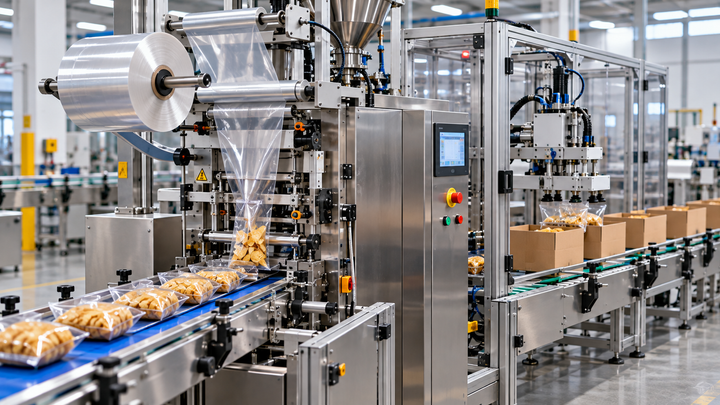
Form-fill-seal equipment forms packaging from a roll of flexible material, fills it with product, and seals the resulting package. Depending on the configuration, packages may be produced vertically or horizontally.
These machines are common in food, powders, granules, and selected non-food applications.
Advantages:
Combines multiple packaging stages in one machine.
Uses roll-fed material for compatible package formats.
Supports consistent package formation when settings are controlled.
Automatic Capping and Sealing Machines
Capping machines apply closures to bottles, jars, and similar containers. Sealing machines may use heat, induction, pressure, or other mechanisms depending on the packaging material and closure design.
Advantages:
Consistent closure application.
Integration with filling and labeling lines.
Potential for closure inspection and rejection.
Automatic Labeling and Coding Machines
Labeling machines apply pressure-sensitive, wraparound, sleeve, or other compatible labels. Coding systems print or mark product identification details on packages, cartons, or labels.
Advantages:
Repeatable label placement.
Support for batch identification and traceability.
Integration with vision systems for code verification.
Cartoning and Case Packing Machines
Cartoning machines form or load cartons, while case packers arrange products into larger shipping containers. The equipment may use mechanical loading, robotic pick-and-place, or other handling mechanisms.
Advantages:
Consistent product grouping.
Reduced repetitive manual handling.
Coordination with end-of-line material movement.
Wrapping and Bundling Machines
Wrapping machines apply film, paper, or other packaging materials around individual products or groups of items. Applications include shrink wrapping, stretch wrapping, and flow wrapping, which serve different packaging purposes.
Advantages:
Supports multiple compatible package configurations.
Helps protect products during handling.
Can integrate with counting, grouping, and case packing.
Robotic Packaging Systems
Industrial robots handle tasks such as pick-and-place, product orientation, case loading, and palletizing. End effectors must be selected for the product's shape, weight, fragility, and handling requirements.
Advantages:
Flexible movement and product arrangement.
Programmable handling sequences.
Potential to accommodate multiple product patterns with suitable tooling and controls.
Inspection and Checkweighing Systems
Automated inspection equipment checks selected quality attributes. Checkweighers measure package weight, vision systems inspect visible features, and other technologies can detect specific foreign materials or package defects.
Advantages:
Consistent inspection against defined criteria.
Automatic rejection of detected nonconforming items.
Production records that support quality monitoring.
Automated Packaging Machine Type Comparison
Machine Type | Primary Function | Typical Package or Product | Main Selection Factor |
|---|---|---|---|
Filling machine | Dispenses product | Bottles, jars, pouches | Product properties and dosing accuracy |
Form-fill-seal machine | Forms, fills, and seals | Flexible pouches or bags | Packaging material and format |
Capping or sealing machine | Closes packages | Bottles, jars, trays | Closure and seal requirements |
Labeling machine | Applies labels | Containers and cartons | Label shape and placement |
Cartoner | Forms or loads cartons | Individual products or multipacks | Carton design and loading pattern |
Case packer | Groups products into shipping cases | Bottles, cartons, pouches | Case layout and product stability |
Wrapping machine | Wraps products or groups | Bundles and individual items | Film type and wrapping method |
Robotic packaging system | Handles and positions products | Variable product formats | Payload, reach, tooling, and flexibility |
Inspection system | Checks specified attributes | Packages and finished goods | Defect type and detection requirements |
Materials and Technical Requirements for Packaging Automation
Packaging Materials
Packaging automation must accommodate the physical and thermal properties of the material being processed. Common materials include paperboard, corrugated cardboard, flexible plastic films, rigid plastics, glass, and metals.
Material thickness, stiffness, friction, sealability, printability, and dimensional variation can affect machine performance. For example, film that stretches unpredictably may disrupt forming and sealing, while inconsistent cartons may cause feeding or erection problems.
Product Characteristics
Products may be liquid, granular, powdered, fragile, sticky, viscous, or irregularly shaped. These characteristics affect feeding, dosing, orientation, transfer, and inspection. Product temperature and sensitivity to oxygen, moisture, light, or contamination may also determine packaging requirements.
Utilities and Facility Conditions
Automated packaging lines may require electrical power, compressed air, vacuum, cooling, or other utilities. Food and pharmaceutical applications may have additional requirements for hygienic design, washdown compatibility, environmental control, or controlled access.
Production and Format Requirements
The line must accommodate the required product mix, package sizes, output targets, changeover frequency, and operating schedule. Available floor space, ceiling height, operator access, maintenance clearances, and material replenishment routes also influence the layout.
Controls and Data Compatibility
Equipment integration requires compatible communication interfaces, coordinated control logic, clear fault handling, and appropriate access permissions. Where traceability is necessary, product identifiers and batch records must remain consistent across the relevant machines and information systems.
Automated Packaging Machines vs. Semi-Automatic Packaging Equipment
The main difference between automatic and semi-automatic packaging equipment is how much of the operating sequence is performed by the machine versus the operator. A semi-automatic machine may control filling or sealing while requiring a person to load, position, or transfer each package. An automatic line coordinates more of these activities through feeding mechanisms, sensors, and control systems.
Feature | Automatic Packaging Line | Semi-Automatic Packaging Equipment |
|---|---|---|
Product feeding | Often automated | Frequently involves manual loading |
Process coordination | Integrated machine controls | Operator coordinates some steps |
Labor involvement | Primarily monitoring and exception handling | More direct product handling |
Changeover | May use recipes and adjustable mechanisms | May require more manual adjustments |
Integration | Designed to connect multiple stations | Often operates as a standalone unit |
Flexibility | Depends on tooling and line design | Can suit varied, smaller production runs |
Main consideration | Integration and system complexity | Manual handling and process consistency |
Automatic packaging is not always the appropriate choice for low-volume or highly variable production. Semi-automatic equipment may provide adequate control with a simpler layout, while a fully automated line becomes more attractive when product flow, repeatability, and coordinated throughput justify the added complexity.
Benefits and Advantages of Packaging Line Automation
Improved Process Consistency
Automated controls repeat defined movements, filling sequences, sealing conditions, and product-handling operations. This can reduce variation caused by inconsistent manual movements, provided that the equipment is correctly calibrated and the incoming materials meet specifications.
Better Coordination Between Production Stages
Integrated controls help synchronize feeding, filling, closing, labeling, and case packing. Buffer conveyors and accumulation zones can absorb some differences in station speeds, reducing the effect of brief interruptions on the entire line.
Reduced Repetitive Handling
Conveyors, feeders, and robotic equipment can reduce repetitive lifting, placing, and transferring. This may improve ergonomics, although automated machinery introduces its own mechanical hazards and still requires appropriate safeguarding.
Improved Inspection and Traceability
Checkweighers, vision systems, code readers, and rejection mechanisms can identify defined packaging defects. When connected to suitable data systems, they can also help maintain records of batches, inspection results, and production events.
More Structured Production Monitoring
Machine controls can record operating states, stoppages, output counts, and fault events. These records help production teams identify recurring delays and distinguish between equipment problems, material shortages, and upstream or downstream interruptions.
Potential for Reduced Material Waste
Consistent forming, dosing, sealing, and labeling can reduce some forms of packaging waste. However, waste reduction depends on process stability, changeover procedures, packaging specifications, and effective handling of rejected products.
Industry Applications of Automated Packaging Machines
Food and Beverage Manufacturing
Packaging lines fill bottles, cans, cartons, trays, jars, and flexible pouches. They may also apply closures, check weights, inspect seals, print batch information, and group products into shipping cases.
Food applications require attention to hygienic design, cleanability, product-contact materials, and the risks of cross-contamination. Products with special shelf-life requirements may need compatible barrier packaging or controlled-atmosphere processes.
Pharmaceutical Manufacturing
Pharmaceutical packaging may involve filling vials, bottles, blister packs, sachets, or cartons. Depending on the product and regulatory requirements, lines may incorporate serialization, code verification, tamper-evident packaging, and electronic batch records.
Equipment selection must account for product protection, validated operating procedures where required, traceability, and controlled handling.
Cosmetics and Personal Care
Creams, lotions, shampoos, fragrances, and personal-care products may require liquid or paste filling, capping, labeling, and carton packaging. Viscosity, foaming, container shape, and appearance requirements influence machine configuration.
Consumer Electronics
Electronic products and accessories may be placed into protective inserts, cartons, trays, or antistatic packaging. Vision systems and identification equipment can help verify product presence, label accuracy, and package configuration.
Chemical and Industrial Products
Packaging lines handle compatible liquids, powders, granules, and other industrial materials in containers, bags, drums, or cases. Chemical compatibility, containment, hazardous-area requirements, and spill prevention must be evaluated according to the material and process.
E-Commerce and Logistics
Distribution operations use automated carton forming, dimensioning, weighing, labeling, sorting, case handling, and palletizing. These systems coordinate packaging tasks with order identification and warehouse material flow.
Agriculture and Horticulture
Seeds, grains, fertilizers, animal feed, and related products may be weighed, filled into bags, sealed, coded, and grouped for transport. Dust control, material flow, bag integrity, and environmental conditions can influence system design.
Industry Applications Table for Automated Packaging Lines
Industry | Typical Products | Common Automated Operations | Important Requirement |
|---|---|---|---|
Food and beverages | Drinks, snacks, sauces | Filling, sealing, coding, case packing | Hygiene and package integrity |
Pharmaceuticals | Tablets, vials, medical products | Filling, blistering, inspection, serialization | Traceability and product protection |
Cosmetics | Creams, lotions, fragrances | Dosing, capping, labeling, cartoning | Viscosity and appearance |
Electronics | Devices and accessories | Placement, protective packaging, labeling | Product protection and identification |
Chemicals | Liquids, powders, granules | Filling, weighing, closure application | Compatibility and containment |
E-commerce | Mixed consumer products | Cartoning, weighing, labeling, sorting | Variable dimensions and order accuracy |
Agriculture | Seeds, feed, fertilizers | Weighing, bagging, sealing | Dust management and package strength |
Industry Standards and Safety for Packaging Automation
Packaging machinery combines moving parts, electrical systems, pneumatic equipment, heated sealing elements, cutting mechanisms, and automated handling. Safety requirements should be established through a documented assessment of the machine, the product, the operating environment, and the tasks performed during cleaning, setup, troubleshooting, and maintenance.
ISO 12100: Safety of Machinery
ISO 12100 establishes general principles for machinery risk assessment and risk reduction. It provides a framework for identifying hazards and selecting appropriate protective measures throughout the machine life cycle.
ISO 24158 Series: Packaging Machinery Safety
The ISO 24158 series addresses safety requirements for packaging machinery. Applicable machine-specific requirements should be reviewed alongside general machinery safety principles.
OSHA Machine Guarding Requirements
In the United States, OSHA requirements under 29 CFR 1910.212 address general machine guarding. Safeguards must protect workers from relevant hazards, including dangerous moving parts and points of operation.
OSHA Control of Hazardous Energy
OSHA 29 CFR 1910.147 addresses the control of hazardous energy during applicable servicing and maintenance activities. Appropriate procedures must account for electrical, pneumatic, hydraulic, mechanical, thermal, and other stored energy sources.
FDA 21 CFR Part 11
For applicable regulated operations, 21 CFR Part 11 addresses electronic records and electronic signatures when the relevant regulatory conditions apply. It is not a general certification requirement for every packaging machine.
Standards and regulations differ by jurisdiction, machine category, and application. A qualified machinery safety professional should confirm the requirements that apply to a particular installation.
Common Challenges and Solutions in Packaging Automation
Challenge | Possible Cause | Appropriate Response |
|---|---|---|
Product jams | Poor orientation or inconsistent feeding | Review guides, feeders, and product dimensions |
Inaccurate filling | Product variation or incorrect settings | Validate dosing performance and calibration |
Weak seals | Incompatible material or unstable sealing conditions | Assess material compatibility and sealing parameters |
Misaligned labels | Container variation or incorrect sensor setup | Adjust registration and inspect label application |
Frequent line stoppages | Equipment faults or poor synchronization | Analyze fault history and station-level performance |
Excessive rejected products | Process variation or overly sensitive inspection settings | Validate acceptance criteria and inspection performance |
Long changeovers | Complex adjustments and format differences | Standardize changeover procedures and tooling |
Conveyor accumulation | Uneven station output or insufficient buffering | Rebalance the line and assess accumulation capacity |
Coding errors | Incorrect data or synchronization problems | Control data entry and verify codes before release |
Difficult maintenance | Poor access or inadequate documentation | Improve access planning and maintenance procedures |
Product damage | Unsuitable gripping or transfer forces | Reassess handling methods and machine settings |
Inconsistent output | Unstable upstream supply or recurring faults | Analyze the full line rather than one machine alone |
Corrective actions should be based on observed operating data and a clear diagnosis. Increasing machine speed without identifying the underlying constraint may worsen jams, defects, and downstream congestion.
How to Choose Automated Packaging Machines
Define the Packaging Process
Identify every required operation, from product feeding and primary packaging through labeling, case packing, and palletizing. Establish which activities must be automated and which can remain manual without compromising quality, safety, or production objectives.
Match the Equipment to the Product
Evaluate product dimensions, weight, viscosity, fragility, temperature, flow characteristics, and sensitivity to contamination. Confirm that contact materials, handling mechanisms, and packaging technology are compatible with the actual product.
Establish Realistic Throughput Requirements
Specify the required output in finished packages per unit of time, along with expected product mix, operating schedule, and changeover frequency. Assess the complete line's sustained performance rather than relying on the maximum speed of an individual machine.
Evaluate Package Formats and Materials
Document container dimensions, film properties, carton designs, closure types, label specifications, and permissible material variation. Determine which formats the line must handle and whether format changes require new tooling or significant adjustments.
Plan Controls and Integration
Review how the machines communicate, exchange product data, handle faults, and coordinate stops and restarts. Confirm that the control architecture supports the required inspection, traceability, and production reporting functions.
Assess Safety and Maintenance
Review guarding, access, emergency-stop arrangements, hazardous-energy isolation, cleaning access, spare-parts needs, and maintenance skills. Equipment should be maintainable without encouraging unsafe shortcuts.
Validate Performance Before Production
Factory and site acceptance testing can verify specified functions, operating sequences, safety features, changeovers, and package quality. Acceptance criteria should reflect the actual product, materials, operating conditions, and agreed production requirements.
Automated Packaging Machine Selection Guide
Selection Factor | Information to Establish | Why It Matters |
|---|---|---|
Product type | Physical properties and handling sensitivity | Determines suitable feeding and packaging methods |
Package format | Container, pouch, carton, bag, or tray | Defines machine configuration |
Output requirement | Target production rate and product mix | Determines capacity and line balance |
Filling accuracy | Required quantity and tolerance | Guides dosing technology and inspection |
Material compatibility | Film, container, closure, and label specifications | Affects sealing, feeding, and package integrity |
Changeover frequency | Number and variety of formats | Influences tooling and adjustment design |
Quality controls | Required inspections and rejection criteria | Defines inspection equipment |
Traceability | Batch, serial, and production records | Determines identification and data integration |
Available space | Layout, access, and utility connections | Influences line arrangement |
Safety requirements | Machinery and product hazards | Establishes protective measures |
Maintenance capability | Skills, access, and spare-parts strategy | Affects operational continuity |
Expansion plans | Future products and process changes | Helps avoid restrictive layouts |
Maintenance Best Practices for Automated Packaging Machines
Preventive Maintenance
Establish inspection and maintenance schedules based on equipment documentation, operating conditions, and production experience. Check mechanical wear, conveyor alignment, lubrication points, pneumatic components, sensors, and other parts identified in the maintenance plan.
Calibration and Process Verification
Verify filling, weighing, inspection, and measurement equipment according to the required accuracy and calibration schedule. Recheck performance after relevant adjustments, repairs, or format changes.
Cleaning and Hygiene
Use cleaning methods compatible with the product, machine materials, and applicable hygiene requirements. Food and pharmaceutical equipment may require documented cleaning procedures, controlled access, and checks that confirm the equipment is suitable for the next production run.
Sensor and Control Inspection
Inspect sensor alignment, cables, connectors, communication status, and control-panel alarms. Changes in sensor performance can cause incorrect product detection, misfeeds, and unexpected machine stops.
Spare Parts and Technical Documentation
Maintain accurate equipment manuals, electrical diagrams, approved settings, parts records, and fault histories. Critical spare parts should be identified according to their failure impact, replacement lead time, and operational importance.
Safe Maintenance Procedures
Before cleaning, clearing jams, or performing maintenance, follow the applicable energy-isolation and machine-specific safety procedures. Never bypass a safety interlock or enter a hazardous machine area simply to restore production more quickly.
Limitations of Automated Packaging Line Automation
Automation can improve repeatability, but it introduces technical and operational constraints that must be considered before implementation.
Initial engineering complexity: Integrated lines require mechanical, electrical, control, and process planning.
Format limitations: Equipment may handle only a defined range of product dimensions or packaging materials without additional tooling.
Changeover requirements: Frequent product variation can reduce productive time if format changes are difficult.
Maintenance dependency: Sensors, drives, controllers, and mechanical assemblies require skilled troubleshooting.
Line-wide stoppages: A failure at one critical station can interrupt upstream or downstream operations if buffering and bypass arrangements are inadequate.
Material sensitivity: Variations in film, containers, cartons, or product properties can disrupt feeding and sealing.
Data and integration risks: Poorly coordinated interfaces may create incorrect labels, traceability gaps, or production-record errors.
Safety obligations: Automation reduces some manual tasks but does not remove the need for guarding, training, and safe maintenance procedures.
A technically advanced line may still perform poorly when product supply is inconsistent, operators are insufficiently trained, or maintenance is neglected. Performance should be evaluated across the complete production process rather than by the sophistication of individual machines.
Future Trends in Automated Packaging Machines
Flexible Packaging Lines
Manufacturers are increasingly interested in equipment that can accommodate multiple package formats and product variants. Quick-change tooling, recipe-based settings, adjustable guides, and modular machine arrangements can help reduce changeover complexity when properly designed.
Machine Vision and Intelligent Inspection
Vision systems can inspect labels, closures, package appearance, and product positioning. Their effectiveness depends on lighting, camera placement, image quality, defined acceptance criteria, and validation under actual production conditions.
Robotics and Collaborative Automation
Robotic systems can perform pick-and-place, case packing, and palletizing tasks. Collaborative robots may be appropriate for selected applications, but their use requires a risk assessment of the complete application, including tooling, payload, movement, and nearby equipment.
Data-Driven Maintenance
Equipment monitoring can record faults, cycle information, motor conditions, and other operating variables. Analysis of these signals may help maintenance teams identify emerging problems and plan interventions before major disruptions occur.
Digital Integration and Traceability
Packaging lines can exchange information with manufacturing execution systems, quality systems, and warehouse platforms. Better integration can support product identification, production reporting, and batch traceability, provided that data accuracy, access controls, and system validation are appropriately managed.
Resource-Efficient Packaging
Automation can support more consistent material use through controlled forming, dosing, sealing, and cutting. Actual reductions in material waste, energy consumption, or packaging weight depend on the process design and the materials selected.
Frequently Asked Questions About Automated Packaging Machines
1. What are automated packaging machines used for?
Automated packaging machines perform tasks such as filling, wrapping, sealing, labeling, inspection, cartoning, and palletizing. They help manufacturers standardize repetitive packaging operations and coordinate product movement across a production line.
2. What is a fully automated packaging line?
A fully automated packaging line coordinates most or all required packaging stages through machinery, conveyors, sensors, and control systems. Human involvement is still needed for supervision, replenishment, changeovers, quality management, and maintenance.
3. What is the difference between automatic and semi-automatic packaging machines?
Automatic machines perform their assigned operations with limited direct manual intervention, while semi-automatic machines require operators to complete some steps, such as loading or positioning products. The appropriate arrangement depends on production volume, product variation, process requirements, and available resources.
4. Which industries use automated packaging equipment?
Food and beverage, pharmaceuticals, cosmetics, chemicals, electronics, agriculture, and logistics operations all use packaging automation. Equipment selection varies according to the product, package format, hygiene requirements, and inspection needs.
5. How do manufacturers determine packaging line capacity?
Capacity is evaluated using the required finished-package output, individual machine cycle rates, product mix, changeover time, planned operating periods, and expected interruptions. The slowest or least available critical station can constrain the performance of the entire line.
6. What role does a PLC play in packaging automation?
A programmable logic controller manages machine sequences, receives sensor signals, controls actuators, and coordinates equipment operation. It can also handle interlocks, fault responses, and communication with other automation components.
7. How do automated packaging machines improve quality control?
They can use controlled filling, repeatable sealing, label verification, checkweighing, vision inspection, and automatic rejection. The effectiveness of these controls depends on correct setup, calibration, validation, and suitable inspection criteria.
8. What should be considered when selecting packaging machinery?
Important considerations include product characteristics, packaging materials, required output, format changes, inspection needs, traceability, available space, safety, maintenance, and compatibility with existing equipment. Selection should be based on the complete production requirement rather than one machine's maximum rated speed.
9. What maintenance do automated packaging machines require?
Maintenance may include mechanical inspections, lubrication, cleaning, sensor checks, calibration, filter replacement where applicable, and verification of safety equipment. The schedule should follow equipment documentation and actual operating conditions.
10. Can automated packaging machines be integrated with existing production lines?
Yes, provided the machines are compatible in terms of product flow, dimensions, operating speed, control interfaces, safety arrangements, and data exchange. Integration planning should also address fault handling, buffer capacity, changeovers, and safe access for operators and maintenance personnel.
Conclusion
Automated packaging machines coordinate product handling, filling, sealing, labeling, inspection, and end-of-line operations through integrated mechanical equipment and control systems. Successful line automation depends on matching the equipment to the product and packaging format, balancing throughput across stations, maintaining quality controls, and addressing safety and maintenance requirements. A carefully planned system can support consistent packaging operations while remaining adaptable to changing production needs.