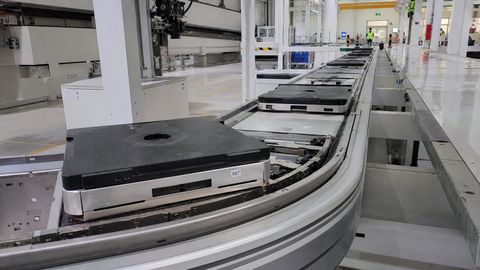
PLC vs SCADA Systems: Overview, Key Differences and Applications
Programmable Logic Controllers (PLCs) and Supervisory Control and Data Acquisition (SCADA) systems are essential technologies in industrial automation.
A PLC executes control logic to operate machinery and processes, while a SCADA system collects operational data, displays process conditions, manages alarms, and enables supervisory control across equipment or multiple locations.
Although they perform different functions, PLC and SCADA systems are frequently integrated to provide real-time machine control, centralized monitoring, and coordinated industrial operations.
Quick Facts About PLC vs SCADA Systems
Feature | PLC | SCADA |
|---|---|---|
Full form | Programmable Logic Controller | Supervisory Control and Data Acquisition |
Primary purpose | Execute control logic | Monitor and supervise industrial processes |
Main operating role | Direct equipment control | Data acquisition and supervisory operations |
Typical hardware | Controller, I/O modules, communication interfaces | Servers, operator stations, communication infrastructure |
Response characteristics | Often designed for deterministic, time-sensitive control | Depends on communication, data updates, and application design |
Common applications | Machines, conveyors, packaging lines, robotic cells | Water networks, power distribution, pipelines, manufacturing plants |
Operator interface | May use a local HMI | Commonly provides centralized graphical interfaces |
Data history | Depends on controller capabilities and connected systems | Commonly includes historical data and event recording |
Geographic scope | Local machine or process, potentially larger | Local, plant-wide, or geographically distributed |
Relationship | Can operate independently or as part of a larger system | Often communicates with PLCs, RTUs, and other controllers |
What Are PLC and SCADA Systems?
What Is a Programmable Logic Controller?
A Programmable Logic Controller is an industrial computer designed to monitor inputs, execute a programmed sequence of instructions, and control outputs. It receives information from devices such as proximity sensors, pressure transmitters, limit switches, and temperature sensors, then determines the appropriate response.
For example, a PLC can control a packaging machine by detecting a product, activating a conveyor, coordinating a filling mechanism, and stopping equipment when a protective interlock is triggered. Its program may include logic operations, timers, counters, arithmetic, communication, and proportional-integral-derivative control.
PLCs are designed for industrial environments and are available in configurations suited to different I/O capacities, control speeds, communication requirements, and environmental conditions.
What Is a SCADA System?
SCADA stands for Supervisory Control and Data Acquisition. It is a system architecture used to gather data from industrial equipment, present information to operators, record events, and support supervisory commands.
A SCADA system commonly includes operator interfaces, communication infrastructure, servers, data storage, and connections to PLCs or Remote Terminal Units (RTUs). Operators can use it to view equipment status, track measurements, acknowledge alarms, analyze historical trends, and issue authorized commands.
SCADA is particularly useful when equipment is spread across a large facility or multiple remote locations. It does not necessarily replace local controllers; instead, it often relies on them to execute control actions close to the physical process.
Why the Difference Between PLC and SCADA Matters
Choosing an industrial automation architecture requires understanding where control decisions occur and where operational information is managed. A PLC may operate machinery reliably without a SCADA system, but it can be difficult to supervise many machines from one location without an appropriate monitoring layer.
Likewise, a SCADA interface can display measurements and issue supervisory commands, but a connected controller usually performs the detailed, time-sensitive control logic.
Understanding this distinction helps engineers plan industrial automation systems, estimate integration requirements, define operator responsibilities, and design appropriate fault-handling arrangements.
Machine automation: PLCs execute equipment sequences and interlocks.
Process visibility: SCADA presents operating conditions through graphical displays.
Alarm management: SCADA can consolidate alarms and events from multiple devices.
Historical analysis: SCADA data storage can support troubleshooting and performance reviews.
Remote supervision: SCADA can connect geographically dispersed equipment.
System integration: PLCs and SCADA work together to connect field operations with operator decisions.
Understanding the Concept: PLC vs SCADA
Simple Explanation
Consider an automated water pumping station. A PLC monitors tank levels, checks operating conditions, and controls the pump according to its programmed logic. A SCADA system displays tank levels, pump status, alarms, and operating trends to an operator in a control room.
If the tank reaches a configured level, the PLC can execute the relevant control action without waiting for an operator to click a button on the SCADA screen. The SCADA system then shows the resulting status and records relevant information.
This division of responsibility allows local control to continue according to its design while operators maintain broader visibility of the process.
Control Layer vs Supervisory Layer
The PLC generally operates at the equipment-control level, where predictable execution and appropriate response to field inputs are important. SCADA operates at the supervisory level, where data presentation, alarms, trends, and authorized commands help personnel manage the overall process.
The distinction is functional rather than absolute. Modern PLCs may include data logging and web-based visualization, while SCADA platforms may perform calculations, scripting, and supervisory logic. The key question is which system is responsible for executing the control action and which system supervises the wider operation.
How PLC and SCADA Systems Work
Step 1: Sensors Collect Process Information
Sensors and field instruments measure conditions such as temperature, pressure, flow, level, position, and equipment status. These signals are connected to PLCs, RTUs, or other compatible acquisition devices.
Step 2: The PLC Processes Inputs
The PLC reads its inputs and executes its programmed control logic. Depending on the application, it may check interlocks, evaluate sensor values, run timers, compare measurements with setpoints, and determine which outputs should change.
Step 3: Outputs Control Equipment
The PLC sends output commands to devices such as motor starters, variable-frequency drives, valves, actuators, and indicator systems. Control actions depend on the programmed sequence, process conditions, and any applicable interlocks.
Step 4: Operational Data Is Transmitted
The PLC or RTU makes selected measurements and status information available to the SCADA system through an industrial communication network. The communication method depends on the equipment, network architecture, distance, and operating requirements.
Step 5: SCADA Displays Process Conditions
The SCADA application presents collected information through graphical screens, equipment diagrams, status indicators, and trend charts. Operators can identify abnormal conditions and view the state of individual machines or the wider process.
Step 6: Alarms and Events Are Recorded
SCADA can generate alarms when configured conditions are met and record relevant events. Alarm priorities, acknowledgment procedures, and event timestamps help operators understand changing conditions and investigate incidents.
Step 7: Operators Issue Supervisory Commands
When authorized, an operator can use SCADA to request actions such as starting a pump, changing an operating setpoint, or selecting an operating mode. The PLC or another controller should validate the command against the local control logic and applicable permissives before acting.
PLC and SCADA Workflow Table
Workflow Stage | PLC Responsibility | SCADA Responsibility |
|---|---|---|
Input acquisition | Reads connected field signals | Receives selected process data |
Logic execution | Executes programmed control logic | Performs supervisory calculations where configured |
Equipment operation | Controls outputs and sequences | Issues authorized supervisory requests |
Process visualization | Provides data through connected interfaces | Displays operating status and measurements |
Alarm handling | May detect local conditions and generate status signals | Consolidates, presents, and records alarms |
Data history | May provide local records | Commonly stores trends and operational events |
Remote monitoring | Communicates through supported interfaces | Presents data from connected sites and devices |
Fault response | Executes configured local responses | Notifies operators and supports diagnosis |
PLC and SCADA System Architecture
Field Devices and Instrumentation
Sensors, switches, transmitters, actuators, and motors interact directly with the industrial process. They provide the measurements and physical responses needed for automated operation.
PLC and Remote I/O
The PLC executes control logic and interfaces with field signals. Remote I/O modules allow input and output devices to connect through distributed arrangements, reducing the need to bring every signal directly to the controller cabinet.
Remote Terminal Units
RTUs are commonly used to collect field data and support remote monitoring and control, particularly at geographically dispersed installations. Depending on the application, an RTU may perform local logic and communicate over radio, cellular, wired networks, or other supported communication links.
PLCs and RTUs can have overlapping capabilities. Their suitability depends on the control requirements, environmental conditions, communication constraints, and system architecture.
Industrial Communication Network
Industrial Ethernet, serial links, and other industrial communication technologies connect controllers, field devices, servers, and operator stations. Protocols are selected according to interoperability, performance, security, and equipment compatibility requirements.
SCADA Servers and Application Layer
SCADA servers and applications collect data, manage configured alarms, provide visualization, and support supervisory operations. System designs may use redundant servers or distributed components to improve availability.
Human-Machine Interface
The Human-Machine Interface (HMI) provides graphical interaction with equipment and processes. An HMI may be a local panel connected to a PLC or part of a larger SCADA environment. An HMI and a SCADA system are related concepts, but they are not interchangeable in every application.
Historian and Data Storage
A historian records time-series process measurements, events, and other operational information. Historical records can help teams analyze production behavior, investigate faults, and identify recurring process deviations.
Main Components of PLC and SCADA Systems
Component | Primary Function | Commonly Associated With |
|---|---|---|
PLC CPU | Executes control instructions | PLC |
PLC I/O modules | Connects sensors and output devices | PLC |
Field sensors | Measure process conditions | Both |
Actuators and drives | Change physical process conditions | Both |
RTU | Acquires and controls remote field data | SCADA architecture |
HMI | Displays process information and operator controls | Both |
SCADA server | Coordinates supervisory data and applications | SCADA |
Communication network | Transfers data and commands | Both |
Historian | Stores time-series operational data | SCADA and integrated systems |
Engineering workstation | Supports configuration, programming, and diagnostics | Both |
Network security components | Help protect communications and system access | Both |
Types of PLC and SCADA Systems
PLC and SCADA are different categories of technology, so their configurations should be considered separately.
Compact PLCs
Compact PLCs combine the CPU and a number of I/O points within a single unit. They are suited to relatively small machines and straightforward automation tasks.
Advantages:
Compact physical footprint.
Integrated components for smaller control applications.
Suitable for basic machine sequences and monitoring.
Modular PLCs
Modular PLCs use a rack or assembly of separate controller, power, communication, and I/O modules. This arrangement allows engineers to configure the system according to the required signals and control functions.
Advantages:
Flexible I/O expansion.
Adaptability to more complex machinery.
Easier configuration of specialized modules.
Safety PLCs
Safety PLCs are designed for safety-related control functions and are evaluated against applicable functional safety requirements. They may monitor emergency stops, protective devices, and other safety functions as part of an engineered safety system.
Advantages:
Designed for defined safety-related applications.
Support for safety diagnostics and fault monitoring.
Integration with appropriately designed safety architectures.
A standard PLC should not be assumed suitable for a safety function simply because it can execute similar logic.
Centralized SCADA Systems
A centralized SCADA architecture places much of the supervisory application and data management within a central control environment. Remote equipment communicates with this central location.
Advantages:
Centralized process visibility.
Consolidated alarm handling and reporting.
Consistent supervision across connected assets.
Distributed SCADA Systems
A distributed SCADA architecture uses multiple connected computing components or supervisory nodes to support operations across a facility or a group of sites.
Advantages:
Distribution of supervisory responsibilities.
Potential for improved availability when designed with appropriate redundancy.
Support for complex operations and multiple control locations.
Networked or Web-Based SCADA
Some SCADA architectures use web technologies or network-accessible interfaces to provide operational information to authorized users. These arrangements can improve access flexibility but require careful authentication, network segmentation, and protection of industrial control functions.
Advantages:
Flexible access from approved locations.
Integration with selected operational data systems.
Potential for simplified visualization deployment.
Remote accessibility should be implemented according to a documented cybersecurity design, not enabled without appropriate controls.
PLC and SCADA Configuration Comparison
Configuration | Typical Scope | Main Strength | Important Consideration |
|---|---|---|---|
Compact PLC | Small machine | Simple, compact control | Limited onboard expansion |
Modular PLC | Larger machine or process | Flexible configuration | Requires careful module planning |
Safety PLC | Safety-related functions | Purpose-designed safety control | Requires a validated safety design |
Centralized SCADA | Plant or multiple remote assets | Unified supervision | Central infrastructure can become a dependency |
Distributed SCADA | Large or multi-site operation | Distributed supervisory capabilities | More complex coordination |
Web-based SCADA interface | Authorized network access | Flexible visualization | Requires secure access and network design |
Requirements for PLC and SCADA Implementation
Control and Performance Requirements
The design should identify required response times, sequence complexity, I/O capacity, control-loop behavior, alarm handling, and availability objectives. Time-sensitive machine control should be assigned to a controller capable of meeting the application's timing and reliability requirements.
Communication Compatibility
PLC and SCADA integration requires compatible communication interfaces, data formats, addressing, and supported protocols. Common industrial technologies include Modbus, EtherNet/IP, PROFINET, and OPC UA, although the protocols serve different purposes and are not automatically interchangeable.
Protocol selection should account for device support, required data rates, network topology, interoperability, and cybersecurity.
Network and Electrical Infrastructure
The installation needs appropriate power supplies, grounding, environmental protection, industrial networking equipment, and cabinet arrangements. Remote sites may also need communication links that can operate under variable connectivity conditions.
Cybersecurity and Access Control
Industrial control networks should be designed with appropriate segmentation, user permissions, authentication, secure remote access, backup arrangements, and change management. The specific controls depend on the system's risk profile and operational requirements.
Operator and Engineering Requirements
Operators need clear displays, useful alarm priorities, and procedures for normal and abnormal conditions. Engineers require documented PLC logic, SCADA configuration, network diagrams, backups, and controlled methods for making changes.
PLC vs SCADA: Key Differences
The most important difference is that a PLC is a control device, whereas SCADA is a supervisory system. Comparing them as if they were competing alternatives can lead to poor architecture decisions because many industrial applications need both.
Comparison Factor | PLC | SCADA |
|---|---|---|
Technology category | Programmable industrial controller | Supervisory control and data acquisition system |
Main role | Local or process-level control | Monitoring and supervisory control |
Logic execution | Executes control programs | May execute supervisory logic, but does not inherently replace the PLC |
Equipment interface | Directly connects through I/O or supported networks | Usually communicates through controllers, RTUs, or data interfaces |
Operator visualization | May provide a local HMI | Commonly provides plant-wide or multi-site visualization |
Alarm management | Can implement local alarm conditions | Commonly consolidates and presents alarms |
Historical records | Depends on controller capability | Often includes historian integration |
Geographic coverage | Often localized, but can be networked | Frequently used across multiple locations |
Dependence on communications | Local control may continue if supervisory communications fail, depending on design | Remote visibility and commands depend on communication availability |
Typical application | Conveyor sequence, machine interlocks, pump control | Water network monitoring, power distribution supervision, pipeline monitoring |
PLC vs SCADA vs DCS
A Distributed Control System (DCS) is another industrial automation architecture that is particularly associated with integrated process control. It is not simply a type of SCADA or PLC, although DCS platforms may contain programmable controllers and supervisory interfaces.
Feature | PLC | SCADA | DCS |
|---|---|---|---|
Primary role | Execute control logic | Supervise and acquire data | Integrated process control |
Typical application | Machine automation | Remote and plant-wide monitoring | Continuous and batch process plants |
Control architecture | Controller-centered | Supervisory layer connected to field control | Multiple integrated control functions |
Operator interface | Local HMI or connected interface | Centralized or distributed supervisory screens | Integrated operator stations |
Process integration | Depends on application design | Connects diverse devices and locations | Designed for coordinated plant-level process control |
Common example | Automated packaging machine | Remote pumping network | Chemical processing plant |
The boundaries can overlap. Large industrial projects may combine PLCs, SCADA, and DCS components according to their control, monitoring, and integration requirements.
Benefits and Advantages of PLC and SCADA Integration
Faster and More Predictable Local Control
PLCs execute programmed logic close to the equipment. This reduces the need to route every control decision through a remote supervisory application and supports time-sensitive operation when the controller and process are appropriately designed.
Centralized Monitoring
SCADA gives operators a consolidated view of measurements, operating states, and alarms from connected equipment. This helps teams understand process conditions without visiting every machine or remote station.
Improved Fault Diagnosis
PLC diagnostics can identify local faults, while SCADA event records and historical trends can provide a broader view of what happened before and after an abnormal condition.
Flexible Automation Architecture
A PLC can control a machine independently, or it can become part of a wider SCADA system. This allows facilities to expand monitoring as additional machines, process areas, or remote sites are integrated.
Operational Data Analysis
SCADA historians can preserve selected process measurements for examining equipment behavior, production interruptions, and process variations. The usefulness of this analysis depends on data quality, sampling, timestamps, and the way information is organized.
Better Coordination Across Locations
SCADA can consolidate data from multiple PLCs and RTUs, helping operators supervise a geographically dispersed network. This is especially valuable when individual assets operate far from a central control room.
Industry Applications of PLC and SCADA Systems
Manufacturing and Packaging
PLCs coordinate conveyors, filling equipment, labeling machines, robotic cells, and packaging sequences. SCADA provides production visibility, machine status, alarms, and historical records across multiple production areas.
Water and Wastewater Management
PLCs control pumps, valves, treatment sequences, and other local equipment. SCADA monitors tank levels, flow measurements, treatment conditions, and alarms across treatment facilities and distribution networks.
Power Generation and Distribution
PLCs may control auxiliary equipment and defined machine functions. SCADA supports supervision of substations, electrical distribution networks, and other connected assets. Critical electrical protection functions require appropriately engineered protective systems and should not be replaced by ordinary supervisory commands.
Oil and Gas Operations
PLC and RTU systems can control local equipment and acquire field data. SCADA provides visibility across pipelines, pumping stations, storage facilities, and other geographically dispersed assets.
Food and Beverage Processing
PLCs execute production sequences and equipment interlocks for mixing, filling, conveying, and packaging. SCADA can provide broader process monitoring, alarms, and operational records.
Pharmaceutical Manufacturing
PLCs can coordinate equipment sequences and process operations. SCADA or related supervisory systems can support monitoring and data collection, subject to the facility's validation, traceability, and documentation requirements.
Building and Infrastructure Automation
PLC-based controllers and supervisory systems can be used in specialized infrastructure applications. Building automation may also rely on dedicated controllers and protocols designed for HVAC, lighting, and facility monitoring.
Industry Applications Table
Industry | PLC Application | SCADA Application |
|---|---|---|
Manufacturing | Machine sequences and interlocks | Production monitoring and alarms |
Water treatment | Pump and valve control | Plant and network supervision |
Power systems | Auxiliary equipment control | Substation and distribution monitoring |
Oil and gas | Local process and equipment control | Pipeline and remote-site supervision |
Food processing | Mixing, filling, and conveying | Process visibility and data records |
Pharmaceuticals | Equipment sequences | Monitoring and operational records |
Infrastructure | Local equipment automation | Centralized asset monitoring |
Industry Standards and Safety
PLC and SCADA projects should use applicable technical standards, risk assessments, and cybersecurity practices. The relevant requirements depend on the intended control functions, industry, jurisdiction, and consequences of system failure.
IEC 61131-3: Programmable Controllers — Programming Languages
IEC 61131-3 defines the syntax and semantics of programming languages for programmable controllers. Its language framework includes Ladder Diagram, Function Block Diagram, Structured Text, and Sequential Function Chart elements.
ISA-95: Enterprise-Control System Integration
ISA-95 provides models and terminology for integrating manufacturing operations with enterprise systems. It helps define interfaces and responsibilities between production control, manufacturing operations management, and business-level planning.
ISA/IEC 62443: Industrial Automation and Control Systems Security
The ISA/IEC 62443 series addresses cybersecurity for industrial automation and control systems. Its scope includes security programs, risk assessment, system requirements, and component security.
IEC 61508: Functional Safety of Electrical, Electronic and Programmable Electronic Safety-Related Systems
IEC 61508 provides a general framework for the functional safety of electrical, electronic, and programmable electronic systems. Where safety functions are required, the system design and validation must follow the applicable safety requirements.
Standards do not automatically make an installation compliant. The responsible engineering team must determine which editions, national adoptions, regulations, and application-specific requirements apply.
Common PLC and SCADA Challenges and Solutions
Challenge | Possible Cause | Practical Approach |
|---|---|---|
Communication failures | Network faults or incompatible settings | Check network health, protocol configuration, and device diagnostics |
Incorrect process values | Sensor faults, scaling errors, or data mapping problems | Verify field signals, engineering units, and tag mappings |
Unclear alarms | Poor alarm prioritization or excessive notifications | Rationalize alarms and define operator response procedures |
PLC program changes cause faults | Inadequate testing or change control | Review, test, document, and authorize program changes |
SCADA displays become unavailable | Server, workstation, or network failure | Assess redundancy and recovery arrangements |
Remote sites lose connectivity | Communication interruption | Design appropriate local control and communication-loss behavior |
Cybersecurity exposure | Excessive access or weak network separation | Apply risk-based security controls and access management |
Missing historical records | Incorrect logging or storage configuration | Verify data collection, time synchronization, and retention settings |
Expansion becomes difficult | Limited capacity or incompatible equipment | Plan I/O, network, server, and integration requirements |
Operators misinterpret screens | Inconsistent displays or poor alarm context | Improve HMI design, training, and operating procedures |
How to Choose Between PLC and SCADA Systems
The first decision is whether the application needs a controller, a supervisory system, or both. A machine that requires automated sequences may need a PLC without requiring a full SCADA deployment. A remote network with many measurement points may need SCADA connected to PLCs or RTUs at individual sites.
Requirement | Suitable Approach | Reason |
|---|---|---|
Standalone machine control | PLC | Executes local control logic |
Local control with a simple operator panel | PLC with HMI | Combines automation and local visualization |
Monitoring several connected machines | PLCs with SCADA | Combines local control with centralized supervision |
Remote pipeline or pumping network | PLCs or RTUs with SCADA | Supports local operation and remote monitoring |
Complex continuous process | Evaluate DCS, PLC, and SCADA architecture | Depends on process integration and control requirements |
Safety-critical machinery | Appropriately engineered safety system | Safety functions need a suitable, validated design |
Historical process analysis | SCADA with historian or another suitable data platform | Preserves operational measurements and events |
Multi-site operation with intermittent connectivity | Local controllers or RTUs with SCADA | Allows local control behavior to be defined independently of the supervisory link |
Questions to Ask Before Implementation
Which control functions must execute locally?
How many sensors, actuators, machines, and remote sites are involved?
What response times and availability targets apply?
Which communication protocols must be supported?
Are alarms, trend charts, historical data, or reports required?
What should happen if the SCADA server or communication network fails?
Are dedicated safety functions required?
How will cybersecurity, backups, testing, and future expansion be managed?
The answers should determine the architecture rather than a preference for one technology.
Maintenance Best Practices for PLC and SCADA Systems
Inspect PLC Hardware and I/O
Check controller diagnostics, power supplies, I/O status, communication modules, cabinet conditions, and relevant fault records. Inspection intervals should reflect equipment requirements and the operating environment.
Verify Program Backups
Maintain controlled copies of PLC programs, configuration files, and system documentation. Verify that backups are current and can be restored through an approved recovery procedure.
Review SCADA Alarms and Historical Data
Check alarm behavior, event records, time synchronization, historian collection, and storage capacity. Investigate gaps in records and recurring alarms rather than treating them as routine background noise.
Monitor Network Health
Review communication errors, device availability, network utilization, and relevant security logs. Changes to industrial networks should be tested and documented because they can affect control and monitoring.
Manage Changes Carefully
PLC logic, SCADA graphics, tag databases, and communication settings should follow a controlled change process. Where appropriate, test changes in a suitable environment before deployment and maintain a recovery plan.
Test Failure and Recovery Behavior
Verify the designed response to communication loss, power interruption, controller faults, and supervisory system outages. Testing should follow documented procedures and avoid creating hazards during live operation.
Maintain Cybersecurity Controls
Review user access, remote connections, security updates, removable media practices, and network segmentation according to the system's risk profile. Changes should be coordinated with operational requirements to avoid disrupting essential control functions.
Limitations of PLC and SCADA Systems
PLC Limitations
A PLC is designed primarily for control execution rather than comprehensive plant-wide visualization and historical analysis. Large applications may require additional controllers, communication infrastructure, engineering effort, and separate systems for reporting or long-term data storage.
Limited onboard resources in some controller models.
Dependence on compatible I/O and communication modules.
Programming and troubleshooting expertise requirements.
Additional integration work when coordinating many machines or sites.
SCADA Limitations
SCADA depends on data from connected devices and the communication infrastructure linking them. A disconnected field device can limit visibility, and a central application cannot guarantee that a remote command will reach its destination.
Network interruptions can affect remote monitoring and control.
Server or application failures can reduce supervisory visibility.
Historical data quality depends on configuration and communication reliability.
Poorly designed screens and alarms can increase operator workload.
Remote access introduces cybersecurity considerations.
Limitations of Integrated Systems
Integrating PLCs with SCADA increases visibility but also adds interfaces, dependencies, and configuration requirements. System designers must define how local controllers behave when supervisory communication is lost, how commands are validated, and how operations recover after faults.
Neither PLC nor SCADA integration automatically provides functional safety, cybersecurity, or regulatory compliance. These capabilities require appropriate engineering, validation, and ongoing management.
Future Trends in PLC and SCADA Systems
Industrial Edge Computing
Industrial edge devices can process selected data close to equipment, reducing the need to send every measurement to a central application. They can support local analytics and data filtering while leaving time-critical control functions with appropriately designed controllers.
OPC UA and Improved Interoperability
OPC Unified Architecture (OPC UA) supports structured data exchange between industrial devices and applications. Its use can simplify integration across compatible systems, although interoperability still depends on configuration, supported information models, and security arrangements.
Advanced Analytics and Predictive Maintenance
Operational data from PLCs, SCADA historians, and condition-monitoring instruments can support the identification of recurring faults and equipment deterioration. These approaches are most useful when measurements are reliable and analytical results are validated against actual process conditions.
Virtualization and System Resilience
Virtualized server environments can simplify the deployment and recovery of selected SCADA applications. However, virtualization introduces dependencies on host infrastructure, storage, networking, and recovery procedures that must be included in the availability design.
Stronger Industrial Cybersecurity
Increasing connectivity makes access control, network segmentation, monitoring, and secure configuration more important. Modernization projects increasingly need to consider cybersecurity throughout system design, operation, maintenance, and eventual replacement.
Frequently Asked Questions About PLC vs SCADA Systems
1. What is the main difference between PLC and SCADA?
A PLC executes programmed control logic to operate equipment and processes. SCADA collects data, displays process conditions, manages alarms, and supports supervisory control across connected devices or locations.
2. Can a PLC work without SCADA?
Yes. A PLC can operate a machine or process independently when it has the required program, I/O, and supporting infrastructure. SCADA is added when centralized monitoring, broader alarm management, historical data, or remote supervision is needed.
3. Can SCADA work without a PLC?
Yes, in some architectures. SCADA can communicate with RTUs, intelligent electronic devices, or other compatible controllers instead of PLCs. It still requires an appropriate mechanism to acquire process data and execute any required physical control actions.
4. Is SCADA a type of PLC?
No. A PLC is a programmable industrial controller, whereas SCADA is a supervisory control and data acquisition system. They are different technologies that commonly operate together.
5. What is the difference between PLC and HMI?
A PLC executes control logic and interfaces with equipment. An HMI provides a graphical interface through which operators view information and interact with the process. An HMI may be connected to a PLC directly or incorporated into a broader SCADA system.
6. What is the difference between PLC, SCADA, and DCS?
A PLC provides programmable control, SCADA provides supervisory monitoring and data acquisition, and a DCS integrates multiple control functions for coordinated process operations. Their capabilities can overlap, and the appropriate architecture depends on the application.
7. Which industries use PLC and SCADA systems?
Both technologies are used in manufacturing, water treatment, power systems, oil and gas, food processing, pharmaceuticals, and infrastructure. PLCs commonly manage local equipment, while SCADA provides wider monitoring and supervisory capabilities.
8. Which communication protocols are used in PLC and SCADA systems?
Common industrial protocols include Modbus, EtherNet/IP, PROFINET, and OPC UA. The appropriate choice depends on device compatibility, communication requirements, interoperability, network architecture, and security considerations.
9. Are PLC and SCADA systems vulnerable to cyberattacks?
Yes. Unauthorized access, compromised engineering workstations, insecure remote connections, and network vulnerabilities can affect industrial control systems. Risk-based security measures include access controls, network segmentation, secure configuration, monitoring, and tested recovery procedures.
10. How should a company decide whether it needs PLC, SCADA, or both?
The decision depends on whether the primary requirement is local equipment control, centralized monitoring, remote supervision, or a combination of these functions. A machine may need only a PLC, while a facility with many connected machines or remote assets may benefit from PLCs integrated with SCADA.
Conclusion
PLC and SCADA systems serve complementary roles in industrial automation. PLCs execute control logic and operate equipment, while SCADA provides broader process visibility, alarm management, historical data, and supervisory control. Understanding their differences helps organizations develop appropriate automation architectures, integrate equipment effectively, and plan for reliability, safety, and cybersecurity.